


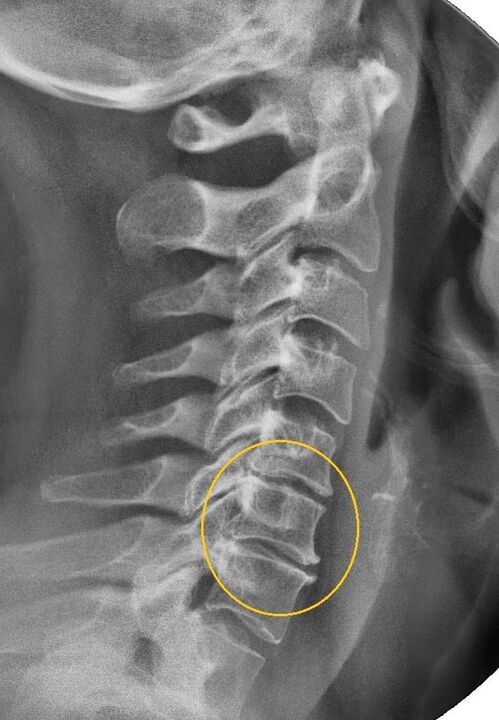
Osteochondrosis of the cervical spine 1 degree is an initial stage of irreversible destructive and degenerative changes in the cartilaginous intervertebral discs and the bone bodies of the vertebrae.It is rarely possible to diagnose the pathology at an early stage of development, since cervical osteochondrosis may not manifest itself clinically.Even on radiographic images, characteristic signs of damage to cartilaginous structures are often absent.
Features of cervical osteochondrosis of the 1st degree
Osteochondrosis of the cervical spine of the 1st degree is often discovered by chance - during the diagnosis of other pathologies, even unrelated to the musculoskeletal system.But sometimes the patient himself comes to the doctor, alarmed by the deterioration of his general health.In fact, despite the lack of pronounced symptoms of osteochondrosis, the intervertebral discs have already undergone degenerative changes:
- cartilaginous tissues have become denser and expanded;
- radial cracks appeared on the fibrous rings.
The loss of stiffness and elasticity of the intervertebral discs has degraded their shock-absorbing properties.Due to their inability to completely relieve the load on the vertebrae, a slight instability of the cervical spine still occurs.But even a slight displacement of cartilage or bone structures becomes a prerequisite for further rapid progression of osteochondrosis.
Clinical picture
With osteochondrosis of the cervical spine of the 1st degree, the characteristic signs of this pathology may be absent.A person explains the discomfort that arises from time to time due to fatigue after physical activity or muscle tension due to a long stay of the body in one position.Gradually, the intensity of the pain in the back of the neck increases.
Intermittent, painful and still mild painful sensations occur first after lifting heavy objects or hypothermia.They do not have a clear localization, often radiating to the shoulders and upper back.A shoulder pain syndrome develops, which becomes the first specific sign of cervical osteochondrosis.In the initial stage of development, the pathology can manifest itself clinically as follows:
- limited mobility in the neck area.When tilting or turning the head, stiffness of movements is felt, which is not accompanied by pain;
- The sensitivity of parts of the body innervated by nerve plexuses common to the cervical region begins to decrease.The sensitivity of the shoulders and forearms decreases, less often - the hands;
- the patient feels a decrease in the muscle strength of the hands;
- Headache and dizziness become more frequent, visual acuity decreases for a short time.


Cervical osteochondrosis of the 1st degree can manifest itself with attacks of sharp, piercing, shooting pain.They usually occur when the head is turned suddenly.This is how the increased tone of the neck muscles is manifested.Their spasms are the body's compensatory response to instability of the spinal segments.
Osteochondrosis is characterized by alternating relapses with stages of remission.During exacerbations, discomfort is constantly felt in the neck.The clinical picture contains vascular, neurological and static signs at the same time.During remission, the disease is practically asymptomatic.
Diagnosis
The diagnosis is made based on the patient's complaints and a series of tests to determine the mobility of the cervical segments.A clue is a history of previous injuries or systemic pathologies of the musculoskeletal system (gout, rheumatoid, reactive arthritis).
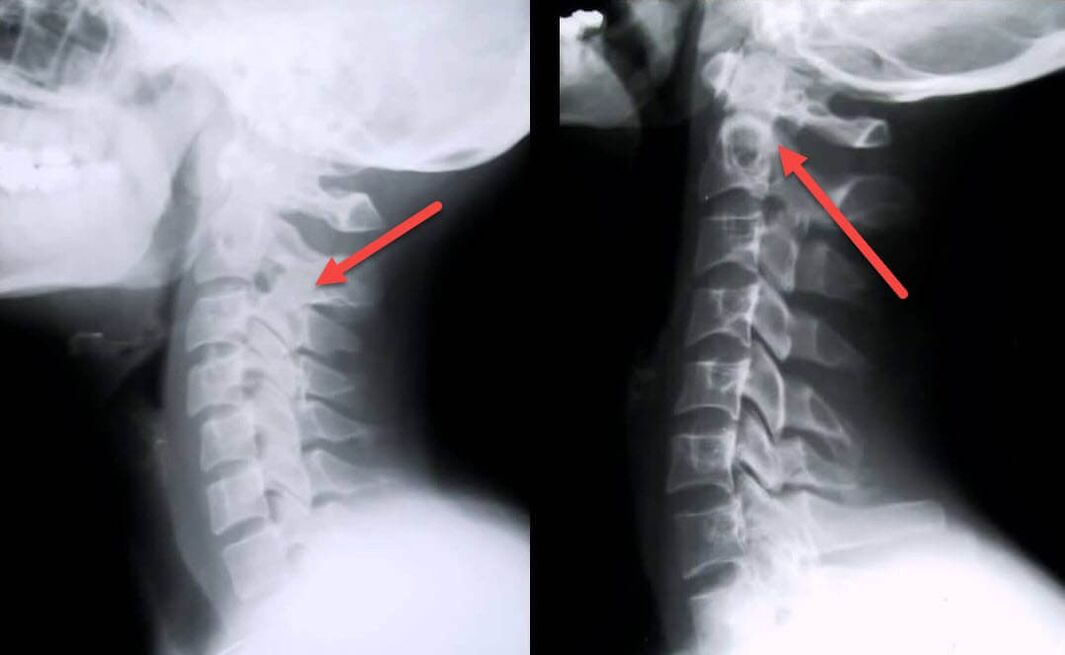
The most informative diagnostic procedure is radiography.Pathologies of the 1st degree correspond to the 1st or 2nd radiological stage.The resulting images visualize the typical signs of the disease.
| X-ray stages of cervical osteochondrosis of the 1st degree | Characteristic signs |
|---|---|
| Stage 1 | Minor changes in the curvature of the spine in the cervical region, affecting one or more segments |
| Stage 2 | Slight thickening of intervertebral discs, deformation of vertebral processes, straightening of lordosis, minor processes of bony structures |
Sometimes an MRI is required to clarify the diagnosis.With its help, you can detect an aseptic, slow inflammatory process and destructive-degenerative changes in the intervertebral discs.
Therapy
Treatment of cervical osteochondrosis of the 1st degree is long-term.In the initial stage of development, the pathology is well affected by conservative therapy.Patients are prescribed medication and recommended physiotherapy and massage treatments.

All treatment methods are aimed at improving blood circulation in the cervical vertebrae.This allows you to avoid deterioration of the trophism of the intervertebral discs - the main reason for the development of osteochondrosis.And the removal of nutrient and oxygen deficiency stimulates the partial regeneration of cartilage tissue.
Pharmacological drugs
Clinically, osteochondrosis of the 1st degree manifests itself with mild pain, the elimination of which does not require the use of drugs in the form of tablets or solutions for parenteral administration.Patients are advised, if necessary, to rub ointments, gels or creams on the back of the neck:
- nonsteroidal anti-inflammatory drugs;
- locally irritating, distracting, warming agents.
In this case, it is even better to use not drugs, but biologically active supplements for external use with camphor, formic alcohol, red pepper extract and bee venom.
Vertebrologists include systemic chondroprotectors in therapeutic regimens.Injection solutions are used over several days.And then the therapeutic effect is consolidated by taking pills.The duration of the treatment course is from several months to 2 years.
Non-drug treatment
For the treatment of osteochondrosis of the 1st degree, physiotherapeutic methods are used, using various physical factors: low-frequency currents, magnetic fields, laser, ultrasound.The procedures help relieve pain, relieve aseptic inflammation and eliminate increased neck muscle tone.

Neurologists and vertebrologists recommend that patients regularly visit the massage room.Due to the dosed mechanical effect on the vertebrae, muscle spasms are relaxed, blood circulation and microcirculation are improved, local immunity is strengthened.The following types of massage are used in the treatment of cervical osteochondrosis:
- classic;
- point;
- vacuum.
Manual therapy with an individually selected method of impact allows you to increase the range of motion in the cervical vertebrae and eliminate the first signs of changes in lordosis.

To restore the anatomically correct shape of the spine or increase the distance between the vertebrae, traction (dry or underwater traction of the spine) is used.

Regular exercise therapy can replace medication, massage, and physical therapy.When performing exercise therapy, blood circulation improves, neck muscles that stabilize the vertebrae are strengthened and tissue trophism is normalized.Daily training is an excellent prevention of pain and stiffness of movement.
The first physical therapy sessions (kinesitherapy) are conducted under the guidance of a physical therapy doctor.It shows how to perform exercises, dosing the load on the discs and vertebrae to avoid compression of the spinal roots.After a few days, the patient can practice independently at home.
The value of timely detection of the disease lies in the favorable prognosis for full recovery.The earlier the therapy was carried out, the greater the probability of full recovery of the functional activity of the spine.